The Protocol is the community's public chronicle: it shows the latest activities of all servants — completed tasks, their ratings, imposed educational measures and lock-up periods. That is where transparency comes from, and it is the basis of the servant ranking.
Note: The screenshots show the German interface — the layout is identical in every language.
Opening the protocol
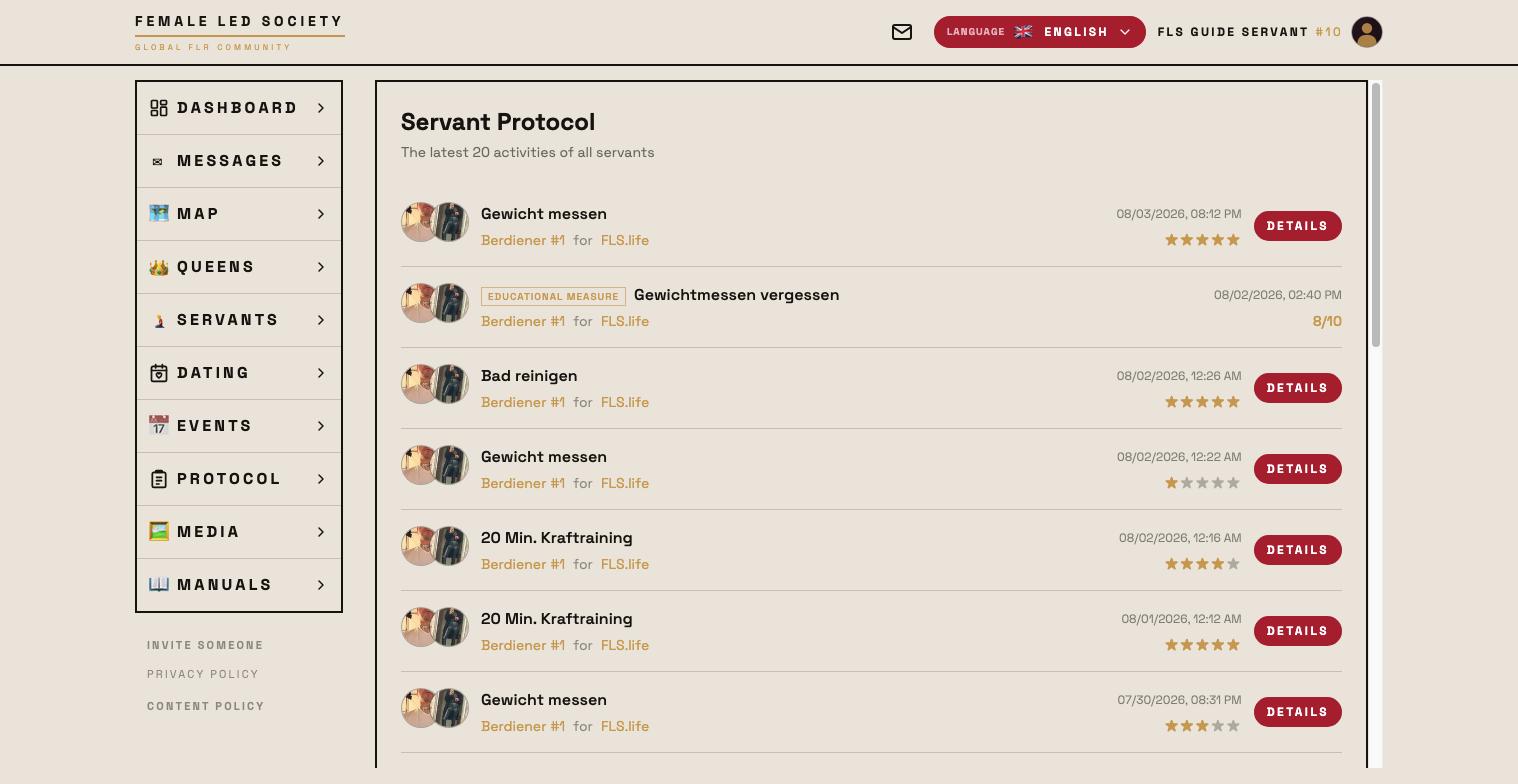
- Open Protocol in the left menu.
- You see the latest 20 activities of all servants, in chronological order — newest first.
What it says
Every entry names who for whom and when: the servant, the queen and the moment. If a servant works on himself without a connection, that is stated explicitly.
There are five kinds of entry:
| Entry | Meaning |
|---|---|
| Task completed | A publicly visible task was finished. |
| Educational measure executed | A punishment was worked through — the entry carries the Educational measure label. |
| ✋ Rule violation reported | A servant reported breaking one of his own rules. No rating; the account stays between queen and servant. |
| 🔒 Locked up | A publicly visible lock-up has begun. |
| 🔒 Lock-up ended | It was unlocked again. |
The rating sits on the right: as stars for tasks, as a number in the form 8/10 for educational measures. In both cases it is given on a scale from 1 to 10 (see Tasks).
Only what has been marked publicly visible appears in the protocol — for tasks the checkbox in the task form, for a lock-up the Publicly visible checkbox. A reported rule violation follows the checkbox of the rule it breaks. Private matters stay between queen and servant.
Viewing details
- Click Details on an entry.
- Depending on the kind you land on the detail page of the task, the educational measure or the lock-up. For a rule violation the way leads to the rule — the violation is listed there in its history.
The task detail page shows the path from Created via Desired completion and Completed to Rated, along with the full description, the submitted proof — images, comment and the filled-in proof fields — and the comments from both sides.
The details of educational measures and lock-ups are only accessible to the two people involved; third parties see no button there.
What it means for the ranking
The ratings in the protocol feed into the placement of the servants (the # number you see in the servants list, for example). Consistently good work improves the placement — missed tasks and punishments make it worse.